Reflections – John 8:34

Jesus answered them, ‘Truly, truly, I say to you, everyone who practices sin is a slave  to sin. The slave does not remain in the house forever; the son remains forever. So if the Son sets you free, you will be free indeed.’

John 8:34 (ESV)

Slavery is a word that hits people hard, especially if they’re American. Across the United States, children will learn in their history classes about the atrocities committed by the slave trade in the 17 and 1800s. Slaves were ripped from their homelands, separated from their families, and forced to live in complete submission underneath their masters who had bought them. They were abused in many senses of the word, and forced into backbreaking labor. They didn’t have any choice but to live this way.  They were bound to their masters, having no power to free themselves.

The characteristics of physical (bodily) slavery relate very closely to those of spiritual slavery. As children of Adam, we are born into spiritual slavery, forced to submit to our master, sin. As a result of Adam’s act of rebellion toward God, the shackles of sin were wrapped around the human race, binding it in death. Every human, no matter how young and innocent-looking, is conceived by sinful parents and born into a sinful world. Like infants, we cannot live without a parent to watch over us. The way Satan would have it, we would live our short lives here on earth, die as sinners, and face God’s eternal and righteous judgment on our own.

That’s not how God would have it.

As Jesus tells us in the verse above, those who practice sin are slaves to sin. As slaves, we cannot remain in the household of God. However, Jesus gives us hope. Those who are sons of God will remain in His house forever. But how can this happen? If we are born as slaves to sin, how can we become sons of God? The answer is simple yet beautiful: we are adopted as sons on account of Christ.

Paul expresses the intricate nature of God’s plan for salvation in Galatians 4:4-5 –

“But then the fullness of time had come, God sent forth his Son, born of woman, born under the law, to redeem those who were under the law, so that we might receive adoption as sons.”

Because sin entered the world through one man, so must sin be conquered through another. We were cast into sin through Adam, who is the father of us all. But we were reconciled to God through the precious atonement of Jesus, giving us a place in God’s house, where He will remain our Father. He has “set us free,” as Jesus tells us in the verse above. This same truth is expressed by Paul in Romans 5:17 –

“For if, because of one man’s trespass, death reigned through that one man, much more will those who receive the abundance of grace and the free gift of righteousness reign in life through the one man Jesus Christ.”

God has placed a seal on our adoption with the precious gift of baptism. There we were marked as His children, reborn through water and the Word. Our baptism assures us of our place in God’s house by killing our sinful humanity and raising us anew in Christ, who is our redeemer. We were adopted by God’s grace, through faith in Christ Jesus. Looking to Christ, we now have the assurance that God is our Father, for life and for eternity.

The Nicene Creed – Uniting Christians Across History

I’ll be honest – church wasn’t a passion of mine when I was a kid. (Hard to believe, right?) I didn’t hate it, I just didn’t completely understand its importance. I can still remember certain things happening in church when I was just a few years old. One of them feels more vivid than the rest: my reaction to the Nicene Creed.

I had always understood that there were two main creeds we confessed in church – The Apostles’ Creed and the Nicene Creed. Of the two of them, the Apostles’ creed was shorter, and easier to understand. Every time our congregation recited the Nicene Creed, I became slightly frustrated. To me, it was just a long-winded version of the Apostles’ Creed. Half the stuff in it didn’t even make sense to me. God from God? Light from Light? What was the point of adding this language when the Apostles’ Creed was a perfectly good summary of Christianity?

The Apostles’ Creed definitely is a eloquent summary of the Christian faith. It highlights all three persons of the Trinity, briefly describing their areas of work and purpose. It predates the Nicene Creed, being an early confession of the Church. Early Church tradition stated that it was actually written by the Twelve Apostles, though realistically it was just a statement formulated later in the Church, having its roots in the true confession of the Apostles. It served the Church well as a confession of the true Christian faith.

The Council of Nicaea
Flash forward to the year 318 A.D. An elder of the Church, named Arius, began teaching and proclaiming that Jesus was not actually God. Rather, He was an exalted servant of the Father, not actually being divine Himself. Arius had a variety of reasons for believing this, citing Jesus’ humanity, death, and display of human emotion as reasons Jesus couldn’t actually be God. At the time that this heresy arose, the Church had not yet officially and explicitly stated the doctrine of Christ’s two natures. The ideas of Arius made sense to many Christians, giving it momentum within some of the Church.[1]

In a reaction to the spreading of this heresy, known as Arianism, a council was called together in the city of Nicaea. The council was a meeting of elders, bishops, and presbyters of the Church. The meeting consisted of a great deal of debate and discussion over the divinity of Jesus. Because His divinity was the main issue, the persons of the Father and the Holy Spirit were not a main focus.

What does this Mean?
The council ultimately ruled against the teachings of Arius; Jesus was declared to be God, just as were the Father and the Holy Spirit. However, the council didn’t just write a simple or vague statement on Jesus’ divinity. The specific wording found in the Nicene Creed was chosen so that there would be no room for another heresy to develop concerning Jesus’ divinity. The Nicene Creed specifically states:

We believe in one Lord, Jesus Christ, the only Son of God, eternally begotten of the Father, God from God, Light from Light, true God from true God, begotten, not made, of one being with the Father. Through him all things were made.

The objective of the phrases “God from God,” “Light from Light,” “True God from true God,” and “begotten, not made, of one being with the Father,” is to emphasize the fact that Jesus and the Father are “of the same substance.” (Known as homoouisios, from the Greek word “μοούσιος,” meaning “same essence.) Jesus’ unity with the Father was emphasized, while still confessing that He is the Son of God. Jesus is confessed as the true and eternal God, just the same as the other two persons of the Trinity. It is also stated that the world was created through Him. The portion of the Creed that is quoted above is the most significant addition to the general template of the Apostles’ Creed.

The implication of Jesus not being God can be discussed at great length, but in summary it has to do with our salvation. No mere human or created creature could be the one to atone the sins of the entire world. It is imperative that God Himself was our atonement.

It is difficult to actually wrap our minds around the fact that Jesus is both God and man. It’s impossible to comprehend that there are three persons, yet only one God. Instead of attempting to understand the great mysteries of the Lord, we humbly submit to the amazing Truth he has revealed to us.

Needless to say, I no longer get upset when confessing the Nicene Creed. It’s my prayer that you, too, would contemplate and recognize the importance of this confession. Ultimately, it unites modern Christians with the historical Church in one faith. Let us rejoice in the fact that Jesus has preserved the one holy and apostolic Church through all of history, and will continue to do so until he returns in glory.

“Therefore Pilate said to Him, ‘So You are a king?’ Jesus answered, ‘You say correctly that I am a king. For this I have been born, and for this I have come into the world, to testify to the truth. Everyone who is of the truth hears My voice.’

John 18:37


1. Justin S. Holcomb, Know the Creeds and Councils, Grand Rapids, 2014, p. 34.

Finding the Trinity in Genesis 1

One of the core concepts in Lutheran and Reformed theology is the christocentricity of Scripture. When we say that the Bible is “christocentric,” we are stating that the entirety of Scripture, whether explicitly or through typology, points to Christ and His saving work. Jesus Himself said, “You search the Scriptures because you think that in them you have eternal life; and it is they that bear witness about me.” (John 5:39). We see images of Christ all throughout the Old Testament, with many of them occurring in the Pentateuch, or “Books of Moses.”

For example, Abraham’s offering of Isaac as a sacrifice to God (Genesis 22) is overflowing with imagery that points to the atonement of Christ. We also see a foreshadowing of Christ when Moses was instructed by God to set a bronze snake on a pole, so that the Israelites who looked upon it would not die (Numbers 21). These are some of the most apparent parallels to Christ found in the Old Testament. Just as the snake was lifted up on a pole, so was Jesus lifted up on the cross. All who looked to the bronze snake were spared their lives. All who look to Jesus as Savior will not perish, but have eternal life.

On the other hand, some of these undertones of christocentricity are harder to spot, buried deeper in the text, sometimes only apparent in the original Hebrew or the minor details. I think it’s worthwhile to take a look at the first few verses of the Bible, found in the first chapter of Genesis.
As a short introduction, let’s examine the Gospel of John 1:1:

In the beginning was the Word, and the Word was with God, and the Word was God.

In his gospel account, John refers to Jesus as the Word and the Light, among other names. John makes it clear that Jesus is the Word of the Father, existing from eternity. Now, take a look at John 1:3:

All things were made through him, and without him was not any thing made that was made.

John is stating that God the Father Almighty created all things through Jesus, a fact that we confess in the Nicene Creed. But what exactly does that mean? This becomes readily apparent when we examine Genesis 1:3:

And God said, “Let there be light,” and there was light.

God spoke the universe into existence with His Word. Jesus is the Word of God. When God speaks, His words have supreme authority, having the power to create worlds and convert hearts. That same Word of God was manifest in the flesh as Jesus Christ, who delivered the gospel of God to the world. When God created, He did so through Jesus.
We shouldn’t forget the third person of the Trinity, the Holy Spirit. Next we look at Genesis 1:2:

The earth was without form and void, and darkness was over the face of the deep. And the Spirit of God was hovering over the face of the waters.

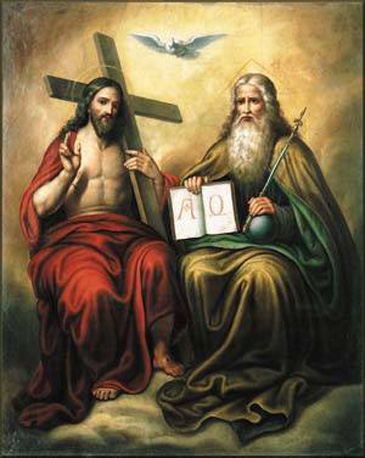
The Spirit of God, the Holy Spirit, was present at creation as well. Even in the first chapter of the Bible, written long before the Trinity was even fully revealed to the world, we see the Triune God at work. We, of course, know that there is only one God. When the Hebrew word of Elohim (God) is used during the account of creation, and even throughout the Old Testament, the word used is a plural noun. There is one God speaking, but referring to Himself as us. All three persons of the Trinity were actively involved at the creation of the universe. We shouldn’t spend too much time trying to understand how the Trinity is possible. Even our best analogies and metaphors used to comprehend this doctrine end up bordering on heresy. Rather, we receive the Word of God in humble reverence, joyful that He has revealed this great mystery to us. And the Trinity is even found in the first verses of the Bible!
The Word of God, through which the world was created, is the same Word that now saves us.

“It is the Spirit who gives life; the flesh is no help at all. The words that I have spoken to you are spirit and life.” —John 6:63